|
Leon County Board of County Commissioners Budget Workshop Item #3 April 25, 2023 |
||
|
To: |
Honorable Chairman and Members of the Board |
|
|
From: |
Vincent S. Long, County Administrator |
|
|
Title: |
Consideration of Proposed Emergency Medical Services MSTU Increase |
|
| Review and Approval: | Vincent S. Long, County Administrator | |
|
Department/ Division Review: |
Alan Rosenzweig, Deputy County Administrator |
|
|
Lead Staff/ Project Team: |
Scott Ross, Director, Office of Financial Stewardship |
|
Statement of Issue:
As presented to the Board during last year’s budget development process, this item considers long-term Emergency Medical Services fiscal strategies to include increasing the EMS millage rate to support funding EMS operations.
Fiscal Impact:
This item has a fiscal impact. This item recommends increasing the EMS Municipal Services Tax Unit (MSTU) by 0.25 mills for a total millage rate of 0.75 mills. This increase will generate an additional $5.46 million in annual revenue for the EMS fund and eliminate the need to transfer any general revenue to support EMS operations.
Staff Recommendations:
Option #1: Establish the maximum Emergency Medical Services (EMS) Municipal Services Taxing Unit (MSTU) for FY 2024 at 0.75 mills.
Option #2: Schedule the first and only public hearing to consider adoption of an Ordinance amending Chapter 11, Article XIII of the Leon County Code of Laws regarding the Emergency Medical Service Taxing Unit, for July 11, 2023 at 6:00 p.m.
Report and Discussion
Background:
Tallahassee Memorial Healthcare (TMH) provided Emergency Medical Services (EMS) within Leon County for over thirty years, funded through fees for services. On September 20, 2002, TMH announced that it would stop providing EMS on June 30, 2003 because the service was operating at an unsustainable deficit. As counties are authorized to provide ambulance services, this announcement required the County to consider how EMS services would be provided Countywide. The County engaged an industry expert to assist in developing several alternatives for EMS system design. The County opted to operate the EMS system as a function of County government as this option provides the most control over the efficiency and effectiveness of the EMS system; allowed the County to contain costs; provided the County with direct control to effectuate changes in service delivery; and created the level of oversight desired by the Board.
The County implemented a hybrid high-performance EMS system model because of the significant operational benefits for response times and the associated cost savings with the dynamic deployment of ambulances, which avoided large capital costs involved with constructing EMS stations throughout the County. Under the County’s hybrid performance system most ambulances are located throughout the community based on factors such as historical call volume, the road network, available resources, and the ability to respond to emergency calls quickly. This hybrid deployment of ambulances allows the County the flexibility to alter coverage patterns, frequently change ambulance staging locations, and positively impact the efficiency and effectiveness of the EMS system. The hybrid model also includes placing fixed ambulances in three rural areas, Woodville, Chaires, and Fort Braden, due to the population density in those areas and the distance and associated time required to respond to calls in those areas and transport patients to the hospital. During the first full year of operation (January 2004 – December 2004), the County EMS Division responded to 26,481 requests for service.
As presented to the Board during the FY 2023 budget development process, this budget discussion item considers long-term EMS fiscal strategies to include increasing the EMS millage rate to support EMS operations. Since the inception of the County EMS Division in 2004, the program has experienced significant increases in call volume and corresponding costs to run the program; however, the EMS millage rate has remained unchanged. To provide taxpayer sensitivity, the County has delayed any property tax rate increases and instead implemented fiscal strategies to drawdown available dedicated EMS fund balances, leveraged additional Federal dollars, and increased general revenue contributions to support the growing demands for services. These deliberate steps taken by the County were intended to avoid property tax increases for County residents while providing fiscal stability for the EMS fund for several years, at which time the increase in the millage would be considered. As has been regularly presented to the Board in agenda items and previous Board workshops, while the County’s efforts have resulted in no increase to the EMS MSTU for 19 years, this strategy now requires an EMS millage increase to fund a 94% increase in EMS call volume over that time.
When initially established as a County department, the funding mechanism for EMS included fees for services and a Municipal Service Taxing Unit (MSTU) set at a rate of 0.5 mills, which as mentioned previously has remained unchanged. The MSTU is levied countywide (unincorporated areas of the county and incorporated area of the City of Tallahassee). As the MSTU is for a countywide purpose, the City of Tallahassee adopted an ordinance to allow the MSTU to be levied in the City limits (Florida law requires cities to approve Countywide MSTUs to be levied within the City limits).
When first implemented, this funding approach resulted in the MSTU providing 52% of revenues while user fees made up 48% of revenue. This strategy established appropriate funding levels to support the cost of operating the EMS system and provided a balanced approach where property taxes were supplemented with user fees. The user fees adopted by the County were recommended by the consultant and were consistent with the customary rates charged by TMH. The fee resolution included an annual increase in fees consistent with the Consumer Price Index, US City Average, for Medical Care as reported by the United States Department of Labor. The consultant found that TMH collected 37% of actual billings, meaning only 37% of total ambulance fees billed to customers for EMS services were collected. The consultant found that the County could achieve a higher rate of success in bill collections, so the County EMS billing model contemplated a 42% collections rate for budgeting purposes.
As is typical for all EMS agencies, the County does not collect 100% of billings. Medicare and Medicaid pay for services based on a fee schedule that is set significantly lower than the amount the County bills for services and the actual cost of providing the service to the patient. In addition, the County is restricted from billing a patient for the unpaid balance of the account under Medicare and Medicaid guidelines. Private health insurers base their payment methodologies largely on Medicare fee schedules and often pay the County an amount lower than the amount billed, leaving the patient responsible for the balance. Additionally, approximately 23% of EMS billing accounts are self-pay/uninsured and a very small number of uninsured patients pay the County for the services provided, which results in annual uncollectable “write-offs.”
In 2018, an analysis of the EMS fee schedule provided by the County’s billing vendor found that the ambulance rates at that time were higher than most other Florida jurisdictions and exceeded 200% of Medicare rates. In response, the County reduced EMS fees by 24% (an average of $250 per EMS account) and implemented a hardship policy to provide greater relief for those customers most in need of financial assistance. Prior to the fee reduction, the County’s collection rate dropped over the 14-year period from the projected 42% to 36%. However, since reducing fees the collection rate has returned to 42%.
As reflected in Table 1, in FY 2004 (the first year of services) the MSTU provided $4.70 million or 52% of the funding for EMS, and user fees accounted for $4.38 million or 48% of funding. As will be discussed in greater detail later in the item, currently user fees provide 40% of funding, the MSTU provides 35% of funding, the EMS fund balance provides 8% of funding, general revenue support provides 7% of funding, and other miscellaneous revenues (increased Medicaid reimbursements, special events, etc.) provide the remaining 10% of funding. The FY 2023 fund balance includes $2.3 million appropriated for EMS vehicle and equipment replacements.
Table 1: EMS Revenue Mix (Millions)
|
|
FY 2004 |
FY 2023 |
||
|
User Fees |
$4.38 |
48% |
$11.69 |
40% |
|
EMS MSTU |
$4.70 |
52% |
$10.15 |
35% |
|
EMS Fund Balance |
- |
- |
$2.49 |
8% |
|
General Revenue Support |
- |
- |
$2.00 |
7% |
|
Misc. Revenues |
- |
- |
$2.84 |
10% |
|
Total |
$9.08 |
100% |
$29.17 |
100% |
To supplement the availability of paramedics in the community, the Board also approved an Interlocal Agreement with the City to provide Advanced Life Support (ALS) first response services (Agreement). Under the Agreement, the County provides annual funding, medical direction, and supplies and equipment to the City for the Tallahassee Fire Department (TFD) to provide ALS. TFD providing ALS is part of the overall dual response system utilized by the County and the City. Under this system, depending on the nature of the emergency call, both an ambulance and a TFD ALS unit will be dispatched. If a TFD ALS unit arrives first, it can administer advanced life support assistance until an ambulance arrives on the scene. The County’s first year payment to the City was $2.3 million. However, the contract provides for an annual inflationary increase to the County’s TFD ALS payment to the City, which has resulted in a FY 2023 payment of $3.58 million.
In July 2013, the County and City negotiated a comprehensive amendment to the Agreement that addressed several significant policy issues, including fire services and EMS. The amendment extended the Agreement for an additional 10 years (commencing October 1, 2015) and also required the City to concur to an increase of up to a quarter of a mill in the EMS MSTU at a point in the future, if the County determines it is necessary. The Agreement requires that the County provide a 60-day notice to the City to conduct the required public hearing to update the City’s EMS MSTU Ordinance.
Analysis:
At previous budget workshops since FY 2014, the Board has regularly been presented information concerning the significant growth in call volume at the EMS Division and the financial condition of the EMS fund. As previously stated, the County has taken deliberate steps to address these growing demands for services while delaying increases in the EMS millage rate for as long as possible. The County has added EMS crews, provided pay adjustments and other employee retention incentives, leveraged Federal funds, implemented multi-year fiscal plans to draw down EMS fund balance, and provided additional general revenue support to provide financial stability for EMS for several years. These plans were intentional in providing funding for much needed expenditures while avoiding anticipated tax and fee increases. The analysis section will discuss in greater detail the approaches the County has taken to meet these demands in the short-term and present strategies to continue fiscal viability for the EMS program in the long term.
The County operates a high-performance EMS system which features the most cost-effective staffing model aligned with the strategic deployment of ambulances, allowing for the most effective and efficient use of available resources in meeting the needs of the community while maintaining high quality services. EMS utilizes advanced medical protocols, provides progressive training to EMTs and paramedics, and consistently deploys state of the art equipment in the delivery of services.
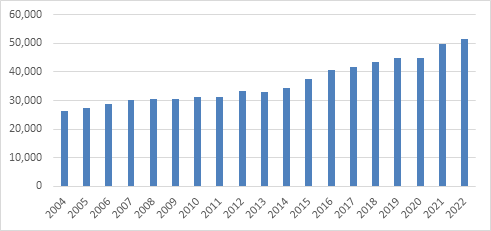
Since the inception of the EMS program, the County has continued to see extraordinary growth in calls for EMS services. As reflected in Chart 1, from 2004 through 2022 the number of requests for services handled by EMS has increased by 94% from 26,481 requests in 2004 to 51,500 in 2022. This level of increased requests for EMS service is consistent with other like-sized communities.
Chart 1 – EMS Calls for Services (2004 -2022)
While relying on the hybrid performance model, over the years the County has implemented several strategies to address the growth in call volumes and the long-term financial health of the EMS fund. These strategies are discussed in the following sections.
Staffing Enhancements & Incentives
Over the years, the County has taken a variety of proactive steps to mitigate the impact of increased call volumes and challenges in retaining EMS personnel to meet these increased demands, including the addition of new ambulance crews and equipment in fiscal years 2006, 2009, 2015, 2018, 2021, and 2023.
Other strategies to enhance staff retention have included implementing a professional development plan, increasing hourly pay rates, implementing alternative scheduling options, enhancing shift pay differentials, implementing extra shift incentive/special day stipends, and continuing to focus on fostering an environment that facilitates long-term EMS careers. Most recently, during FY 2022 to address the unprecedented challenges created by the COVID pandemic to recruit qualified EMT and paramedic applicants, the County implemented a EMT to Paramedic Trainee Program. Under this County-funded program, five full-time EMT positions were created within the EMS Division to enroll in and complete a paramedic training and certification program while employed by the County as EMTs on a full-time basis. To further enhance recruitment, beginning in Fall 2023, the County is also partnering with Tallahassee Community College to offer a one-year EMT Certification Program to seniors on Godby High School’s campus. Students will be able to complete the certification program during their senior year and upon graduation begin working as a certified EMT.
The previous long-term efforts to address the fiscal cost of these additional staffing enhancements and incentives, as well as previous growth in staffing, is discussed in the next section of this item.
Planned Drawdown of EMS Fund Balance/Multi-Year Fiscal Plan
At the FY 2015 budget workshop, an update was provided to the Board discussing the long-term plan for EMS funding. At that time, the program was funded by 52% fees, 39% MSTU, 8% EMS fund balance, and the remaining 2% derived from other miscellaneous sources. Chart 2 shows how expenditures began increasing above the primary revenue sources for EMS (fees for services and MSTU) beginning in FY 2015. The “gap” between revenues and expenditures is currently being paid from general revenue and EMS fund balance.
Chart 2: EMS Revenue & Expenditure Variance (FY 2004-2022)
|
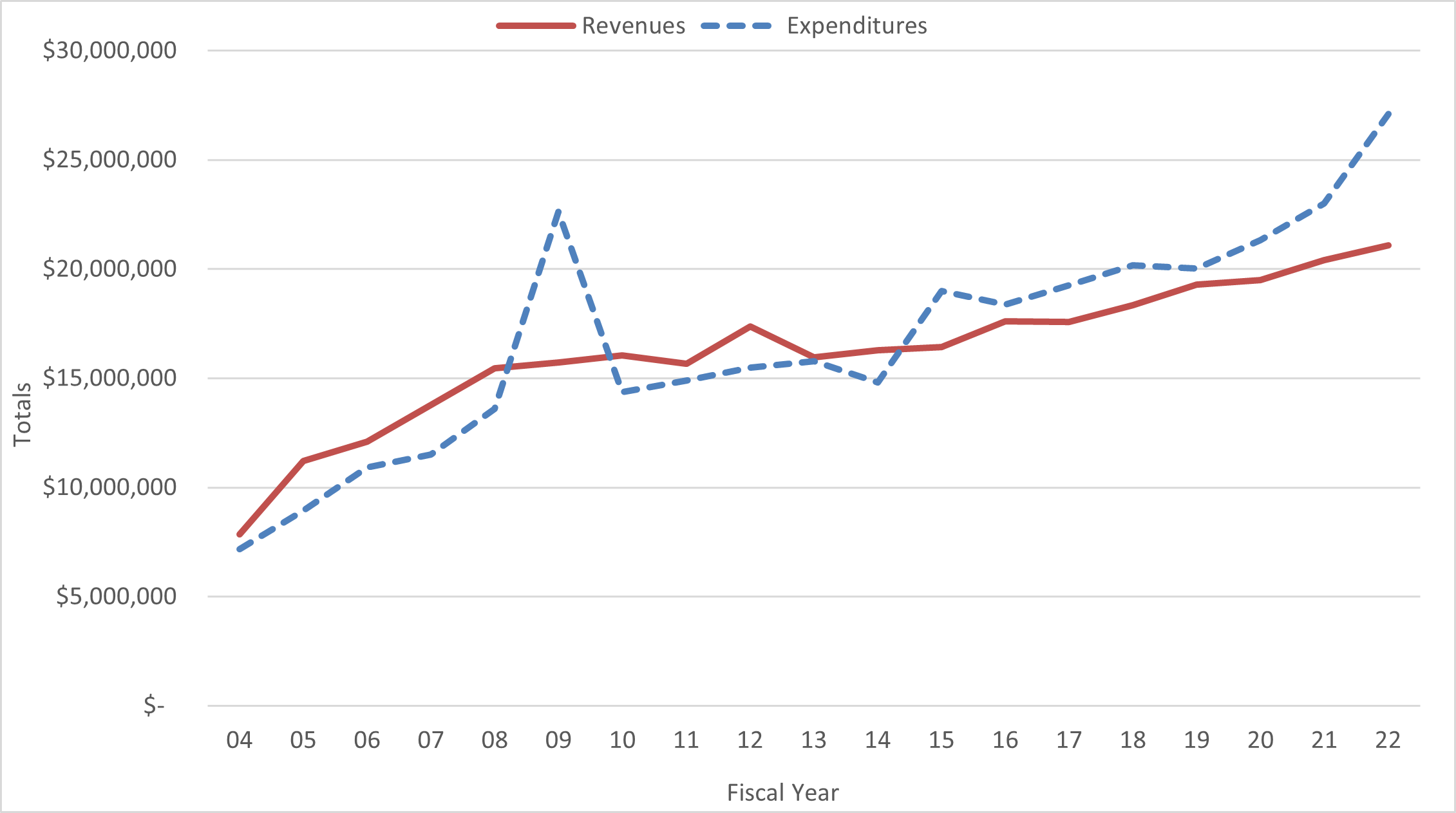
*The spike in expenditures in FY 2009 is related to an appropriation of $4.0 million of EMS fund balance for construction of the EMS Facility located at the Public Safety Complex, and additional funding for a new ambulance crew and equipment.
Over the past 19 years, the County has mitigated any EMS millage rate increases and instead pursued funding strategies that allowed the County to sustain EMS operations with minimal financial impact to citizens. In doing so, the County has passed on $20 million in savings to Leon County taxpayers. Specifically, since FY 2015 the County has implemented the following fiscal strategies to drawdown available dedicated EMS fund balances, leveraged additional Federal dollars, and increased general revenue contributions to support the growing demands and costs for services.
- In FY 2015, the County approved a long-term financial plan to drawdown available dedicated EMS fund balances. These fund balances have been used to balance the annual EMS operating budget and provide necessary funding for additional ambulance crews and equipment.
- In FY 2019, the Board approved a plan to use a portion of debt service savings to pay for EMS services. This plan contemplated a temporary transfer up to $2.0 million of general revenue to the EMS fund beginning in FY 2021. These transfers have totaled approximately $4.3 million over the past three fiscal years.
- Beginning in FY 2020, the County began leveraging EMS revenues through a new State and Federal Medicaid Managed Care Supplemental Payment Program which provided increased payments to the County for Medicaid patients transported by County EMS. Since FY 2020, the County has leveraged $2.0 million in EMS funding and received $5.8 million in additional reimbursements from the State.
- At the FY 2023 Budget Workshop, the Board approved the transfer of $2.0 million in remaining CARES funds to offset the significant expenditures incurred for providing EMS services during the height of the COVID pandemic. These additional funds allowed the MSTU increase to be delayed for an additional year.
While the consideration to increase fees/property taxes was deferred during FY 2023, the Board was advised a future budget discussion item would be presented to address a long-term EMS fiscal plan during the FY 2024 budget process. The following section presents options for the Board to consider in providing long term financial stability for the EMS fund.
Proposed Future Financial Strategies
As discussed throughout this item, the County has taken deliberate steps over the past several fiscal years to delay a taxpayer increase in the EMS millage rate and/or EMS fees for as long as possible. Consistent with the long-term fiscal plan for EMS approved by the Board in FY 2015 and FY 2019, this item recommends an increase in the EMS millage rate to fund EMS services. The previous plan provided for the drawdown of planned EMS fund balance until such time that the fund balances approached a level consistent with County policy and increased general revenue support until FY 2021, at which time it would be necessary to consider increasing the EMS MSTU. As noted previously, this millage increase was avoided in FY 2021 due to an increase in Medicare funding from the State.
To support the on-going needs of EMS, eliminate the general revenue subsidy and support the annual increase to the City for ALS, this item recommends increasing the EMS MSTU by 0.25 mills for a total millage rate of 0.75 mills. This increase will generate an additional $5.46 million in annual revenue for the EMS fund and will eliminate all recurring general revenue required to balance the fund. Moreover, this increase provides sufficient revenue to support EMS operations while providing for the future staffing and equipment requirements for the program, which includes increased staffing and vehicles over the next five years.
This option would have an impact on property tax bills. The impact would be $36 annually for a median assessed homesteaded property. The increase in the millage rate would fund the needed budget to maintain EMS service levels, and not require the further use/depletion of fund balance. Table 2 reflects the fiscal impacts of assessed properties with a $50,000 homestead exemption.
Table 2: Fiscal Impact of Proposed 0.75 EMS MSTU Millage Rate
|
Taxable Value |
Current: 0.50 mills |
Increase: 0.25 mills |
Total 0.75 mills |
|
$144,250* |
$72 |
$36 |
$108 |
|
$200,000 |
$100 |
$50 |
$150 |
|
$300,000 |
$150 |
$75 |
$225 |
*Average Assessed taxable value
EMS operations are structured differently around the State with models for services ranging from private companies, hospital-run, fire departments, and contracts between County EMS and fire departments. The County’s proposed 0.75 millage rate is less than other jurisdictions in the State with similar structured EMS/Fire-ALS programs. Pinellas, Lake and Osceola Counties are similarly structed and have EMS MSTU’s ranging from 0.8775 to 1.0682 mills.
Under the current EMS MSTU Ordinance (Attachment #1), the millage rate is capped at 0.5 mills. If increased, a public hearing to adopt the ordinance would be required to raise the millage cap. Under Florida Statutes, countywide MSTUs also require the approval of the City. In July 2013, the County and City negotiated a comprehensive amendment to the Interlocal Agreement for Fire and ALS, which requires the City to concur to an increase of up to 0.25 mills for the EMS MSTU at a point in the future, if the County determines it is necessary. Pursuant to the interlocal agreement, the County must provide a 60-day notice to the City to conduct the required public hearing to update the City EMS MSTU Ordinance which upon Board approval will be provided by the County Administrator to the City.
This item recommends the County schedule the public hearing to consider adopting an ordinance to increase the EMS MSTU for July 11, 2023. Conducting the public hearing in July will establish the maximum rate to be considered at the budget hearings in September and allows the County time to comply with the statutory Truth in Millage Requirements (TRIM).
Options:
- Establish the maximum Emergency Medical Services (EMS) Municipal Services Taxing Unit (MSTU) for FY 2024 at 0.75 mills.
- Schedule the first and only public hearing to consider adoption of an Ordinance amending Chapter 11, Article XIII of the Leon County Code of Laws regarding the Emergency Medical Service Taxing Unit, for July 11, 2023 at 6:00 p.m.
- Board direction.
Recommendation:
Options #1 and #2
Attachment: